Understanding the Birth Chart as a Living System
~6 min read · Updated January 2026
Astrology isn’t something you read once and understand.
It unfolds layer by layer — as you stay with it.
This page gathers those layers.
Different paths, different tools, different ways of listening to the sky.
But every language has a beginning. So before we go any further, let’s return to where this one first took shape. Here’s a look back at where astrology comes from — how watching the stars slowly turned into a system that connects observation, meaning, and story.
🪔 Babylon → ✨ Egypt → 🌅 Petosiris → ⚖️ Manilius → 📜 Golden Age → 🌙 Ottoman → 🪶 Lilly → ✨ Simgology
Where the language of the stars first began
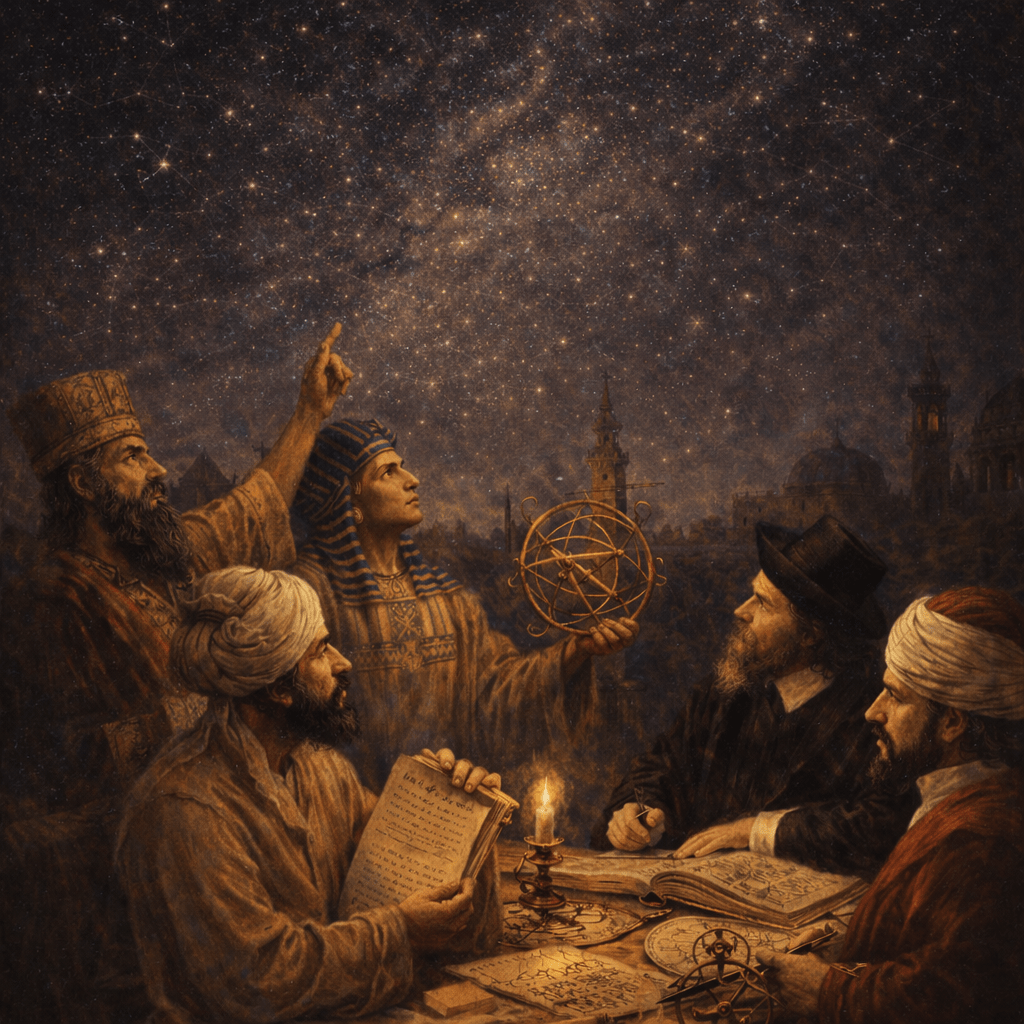
Astrology didn’t start as entertainment — it began as observation.
Long before modern science, humans looked to the sky to understand rhythm, order, and divine timing. The art we now call astrology is as old as storytelling itself.
Its roots reach back to Hermes Trismegistus — known in sacred traditions as Idris, a prophet of wisdom said to have lived before the Great Flood.
From Babylon and Assyria, where the earliest known zodiac had 18 constellations, humans learned to read the sky like scripture — watching the heavens to interpret divine order and timing.
In Egypt, scholars refined the Babylonian system into the 12-sign zodiac around 600 BCE, shaping the astrological language still used today. The stars were seen as mirrors of human nature — a sacred dialogue between earth and sky.
By the 1st century BCE, Egyptian priest Petosiris introduced the concept of the Ascendant, marking the soul’s horizon—the point where heaven meets earth.
A century later, Manilius, the Roman poet–astrologer, divided the sky into four quadrants, mirroring the four stages of human life: birth, growth, maturity, and completion.
Astrology then travelled through Persia and the Islamic Golden Age, where scholars preserved and expanded the Greek and Egyptian teachings — giving us the very words zenith, azimuth, and almanac.
In the Ottoman Empire, it evolved into an imperial science known as ‘İlm-i Nücûm’. The Sultan’s Müneccimbaşı, or Chief Astrologer, advised the palace on the timing of battles, royal marriages, and the birth charts of princes (Şehzade). It was believed that the alignment of the heavens reflected the harmony of the empire itself — and when the art began to fade, so too did that golden order.
Centuries later, in 17th-century England, William Lilly brought astrology to the people through the world’s first newspaper horoscopes.
And now, here I am — an astrologer in London, the same land where Lilly once wrote Christian Astrology, working with astrology as a system of timing and meaning.
Still reading the same stars that once guided kings ✨
A sacred science, not superstition
Astrology was never meant to predict fate — it was designed to reveal patterns. It has always been a conversation between sky and soul.
From Mesopotamia to the Ottoman court, rulers once sought the stars not to control destiny but to align with divine timing — when to act, when to wait, and when to trust.
Even Carl Jung described astrology as “the summation of all psychological knowledge of antiquity.”
Perhaps that’s why, despite modern skepticism, it continues to re-emerge — a reminder that the universe still speaks in symbols to those who choose to listen.
What astrology still teaches us
Astrology is not about fortune-telling. It’s about remembering. Every planet marks a movement of your soul.
- Planets show what is acting.
- Signs show how it expresses itself.
- Houses show where it manifests.
Together, they form your cosmic fingerprint — a reflection of who you are and who you’re becoming.
Where to start 🌙
If you’re new to astrology, don’t try to understand everything at once. Start with the foundations of your birth chart:
- 🌞 Zodiac Signs — how energy expresses
- 💫 Planets & Meanings — what is active
- 🏠 Houses Explained — where it shows up
- 🪐 Birth Chart Basics — the structure behind what you see
Together, they form your personal system — not something to memorize, but something to recognize.
If you want a structured interpretation of your own chart, you can explore my readings.
You may start with your Big 3 (Sun, Moon, Rising) — a simple entry point into your chart.
You can also get weekly insights on emotional patterns, timing, and self-awareness — delivered every Thursday via Simgology Substack.
FAQ
Is astrology a science? Not in the conventional sense — not in the way we use the word today.
Astrology isn’t about experiments or proof. No lab, no equations. It’ closer to reading a text than testing a theory.
For centuries, astrologers worked with symbols, stories, and observation. They watched patterns repeat, wrote them down, argued about them, disagreed — and passed that knowledge on.
You don’t “prove” astrology. You recognize it.
Think of it less as a science — and more as a symbolic language people have used for centuries to understand timing, character, and cycles.How is this different from horoscopes? Horoscopes are simplified — they look at one piece of the picture.
Your birth chart is the whole map.
It’s based on the exact moment you were born and includes your Sun, Moon, Rising sign, planets, houses, and how they interact with one another. That’s why two people with the same Sun sign can feel completely different — their charts tell very different stories.What if I’m skeptical? You don’t need belief to notice patterns. Start with your Big 3 and watch how the Moon’s sign/phase correlates with mood, focus, and interactions.
Astrology doesn’t tell you what will happen. It shows you when something is ready to move.